No feeling is without aim, as there is nothing in the universe without its use. Hence these morbid sensations reveal to the physician that there is disorder. To establish freedom should be the aim of the physician, and if a physician's work does not result in placing his patient in freedom, he cannot heal the sick, for healing the sick is placing the patient in freedom, giving him absolute physical freedom.
Does allopathy physician give that physical freedom to a person suffering from disease?
If the physician causes the pains to stop by a dose of Morphine, can we call that freedom ? Is the patient not made stupid beyond the recognition of the nature of his feelings ? The large doses of the old school does not produce freedom. We must look elsewhere to find that kind of healing which turns disorder into order and makes man free.
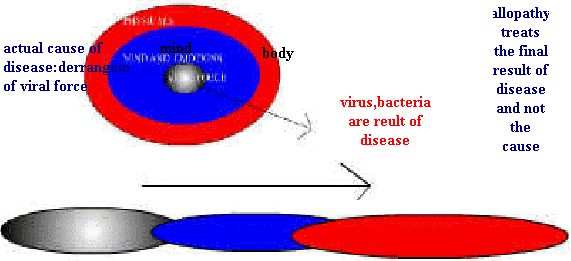
In order to cure permanently derangement from the centre (vital force) should be corrected and not in the ultimate pathology which is only the result of the disease. Allopathy physician may remove virus ,bacteria etc by powerful anti viral treatment for the former and antibiotics for the latter believing that they have removed the disease by removing bacteria or viruses. We can see that bacteria and viruses are product of disease and not the cause. Cause of the disease is different from the ultimate result of disease which may be virus, bacteria etc. Cause is in the centre (vital force). Killing virus or bacteria (by anti viral or antibiotic )does not relieve the disease because they are the product of disease. Soon after the treatment by so called antiviral or anti bacterial medicines (allopathy) the centre should finds expression through some other organs and disease affects newer organ. Only way to treat is treat the centre which is dynamic by dynamic medicine (Homoeopathic medicine)
Homoeopathy remove the cause of the disease and gives freedom in both physical and mental level
By removing the signs and symptoms in an systematic way, by converting disorder into order so that the symptoms no longer have a cause (for as we have already seen when the economy is turned into order it ceases to give forth symptoms), we place our patients in freedom, both physical and mental.
"Only the vital principle thus disturbed can give to the organism its abnormal sensations and incline it to the irregular actions we call disease."
If vital force deranged always cause disease then what is the significance of naming disease?
Most of the conditions of the human economy that are called diseases in the books are not diseases, but the results of disease. e.g., calling Bright's disease, cancer, or palsy, diseases.
To call a cluster of symptoms a disease of one part, and another cluster of symptoms a disease of another part is incorrect and leads to errors in prescribing that can never be corrected. Organic change is the result of disease. Morbid disturbances can be perceived solely by means of the expression of disease in the sensations and actions !
We would have no means of comprehending the morbid disturbance of the invisible principle except by morbid sensations, and if these were not present we would have no means of putting the patient in freedom.
Incurable disease
There are patients so sick that they cannot be put in freedom, those for whom there are no means of cure, and in these, while the internal structural changes are going on slowly, the external morbid symptoms are not present. Such patients continually change doctors and change climates, recognizing, as it were, that no one is capable of relieving them.
With an incurable change in a vital organ, all or most of the symptoms that existed go away ; the symptoms of the diseases are suppressed, as it were, by the tremendous strain upon the system. This is particularly true of the malignant forms of disease results.
The symptoms that existed years ago have disappeared . Those are the symptoms that would manifest to the physician the nature of the remedy, for they give to him the real image of the sickness.